Monday, 08 Feb 2010 01:24 AM
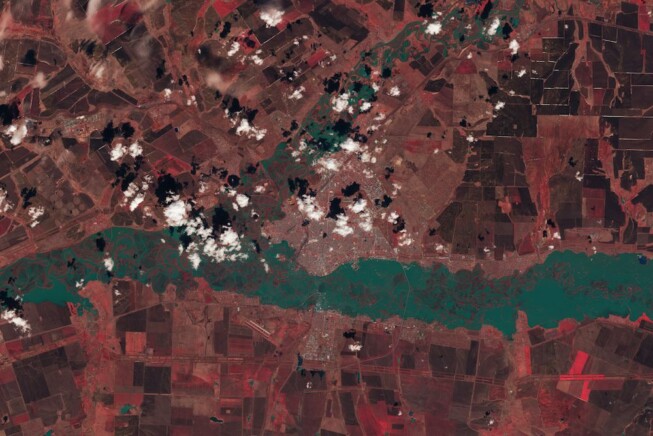
Rice harvesting in the Mekong Delta is lower than what it could be. Only 28% of the 420,000 acres under cultivation benefit from high technology, suggesting large increases in production could be achieved with more technology input.
More on Geospatial TechnologyMonday, 01 Feb 2010 02:07 PM
There are many ways that the height of a mountain can be determined. Altimeters are the easiest approach but theodolites, global positioning systems (GPS) and satellite imagery can also be used.
More on Measuring HeightsWednesday, 27 Jan 2010 08:53 AM
The International Centre for Integrated Mountain Development in Kathmandu has issued a statement on the recent controversy on the rate of glacial melting. In 2007, the UN' Intergovernmental Panel on Climate Change issued a report called AR4. The report repeated a claim made by Professor Syed Hasnain in 1999, published in New Scientist magazine, in the UK, that glaciers in the Himalaya, would melt completely by 2035.
More on Glacial MeltingTuesday, 26 Jan 2010 10:27 AM
The year 2010 is termed the 'Year of the Laser' to many people. Since inventor, Theodore Maiman demonstrated the first laser in 1960 at Hughes Research Labs in Malibu, Calif., the study of light or 'photonics' has grown and expanded immensely.
More on LIDAR MeasurementTuesday, 19 Jan 2010 09:30 AM
China has launched the third satellite in its Compass global satellite navigation system. It was launched from Xichang Satellite Launch Centre in southwestern Sichuan province at about 0:12 a.m. Beijing Time on 17 January.
More onSunday, 17 Jan 2010 12:05 PM
Agricultural production is highly linked to land resources and their location. Recently Deputy Prime Minister Nguyen Sinh Hung suggested that Viet Nam needs to set higher targets for agricultural production. He pointed to the need for better models that link economy to production for local conditions.
More onThursday, 14 Jan 2010 09:12 AM
Imagery from the Malaysian Razaksat satellite will be available to users during the next few months. Speaking at the International Maritime and Aerospace Exhibition in LangKawi, deputy science technology and innovation minister Fadillah Yusof said the configuration process to sharpen the imagery from the satellite was still not completed.
More on RazakSATThursday, 14 Jan 2010 08:58 AM
On 12 January, David Drummond, Google Inc's chief legal officer published a blog announcing his company was considering its position in the Chinese market, after officials there attempted to hack email box belonging to civil rights activists, both inside and outside China.
More on Google in ChinaThursday, 07 Jan 2010 12:37 PM
Navteq in Singapore has released statistics that provide a perspective on the state of the Asian consumer navigation industry in 2009.
More on NAVTEQ in AsiaThursday, 07 Jan 2010 11:34 AM
An official with the State Bureau of Surveying and Mapping in Xian says China will put a high-definition survey satellite into space in 2011.
More - China Plans Hi-res SatelliteTuesday, 05 Jan 2010 07:22 PM
TechNavio Insights recently completed a report that analyzes the prospects for the Geographic Information System (GIS) market in China from 2008 to 2012. The report summarizes the wide range of applications of GIS technology, and aims to inform government policy so that the market will grow and thrive.
More on China GIS MarketMonday, 04 Jan 2010 12:05 PM
Five years after the Indian Ocean tsunami, Indonesia’s early warning system remains a work in progress, officials and experts say.
More on Indonesia TsunamiTuesday, 29 Dec 2009 02:37 PM
Nagasaki has played an important role as a port of diplomacy and trade. For example, Dejima of Nagasaki was the sole port of external trading for more than 200 years during the Tokugawa Shogunate, who decided to close the country in 1633.
More on Nagasaki and Warship Is.Saturday, 19 Dec 2009 04:21 AM
Adaptation and mitigation of rural lands are complementary, not mutually exclusive, approaches to tackling climate change, says a new report from the International Centre for Integrated Mountain Development.
More on REDDTuesday, 01 Dec 2009 12:00 AM
Within the next year, production satellites for the Japanese QZSS system, the Chinese Compass, and the European Galileo constellation will all enter service. That's not really news. The timetable was already on the slate in 2000, and for all the pratfalls and pitfalls along the way, system providers have largely stuck to their guns. So, the evidence seems to be that it takes about a decade for the GNSS to evolve. That begs an interesting question: what will the GNSS look like in 2020?
More on GNSSWednesday, 25 Nov 2009 11:12 PM
Scientists have completed a laser scan survey of the Zhoukoudian cave system. Zhoukoudian is famous for its archaeological discoveries, including one of the first specimens of a Chinese variant of Homo erectus, also known as Peking Man.
More on ZhoukoudianWednesday, 18 Nov 2009 01:53 AM
The Endemic Species Research Institute in Taipei intends to develop a Biodiversity Geographic Information System. It will consist of an internet portal driven by a GIS. The developers say it will offer users a more convenient query interface, and better data management and survey tools.
More on the instituteTuesday, 17 Nov 2009 11:05 PM
New research by a World Action project has measured the extent of forest degradation in the foot hills surrounding Siam Reap in Cambodia. Siam Reap is the nearest town to the famous temple complex at Angkor Wat. In recent years it has expanded rapidly.
More on the projectSaturday, 31 Oct 2009 07:18 AM
Yinguang Lane in Beitou, a suburb of Taipei, is famous for its hot springs, and for the rich variety of ferns and other plants growing in the laneways of the district. Now, tourists can hire a smartphone from the hotel that will help them navigate in the area
More on E-narratorMonday, 19 Oct 2009 06:55 AM
NASA's LCROSS mission to the moon last week will have entertained remote sensors. It was an exhibition of high speed remote sensing as much as anything else. Typically, space sensors last for years – and scientists and engineers spend months calibrating and testing before the instruments go into service. But in this case, the instruments only had a few seconds to capture the data.
More on LCROSS